

How to Verify Ethically Sourced Crystals
Table of Contents
- What Defines Ethical Sourcing in the Crystal Industry
- Understanding the Environmental Impact of Mining
- How to Identify Fake Crystals and Treated Stones
- Crystal Supply Chain Transparency: What to Look For
- Questions to Ask Your Crystal Supplier
- How to Buy High Quality Crystals Online Responsibly
- Verification Steps You Can Take Today
- Frequently Asked Questions
Last Updated: September 1, 2026
What Defines Ethical Sourcing in the Crystal Industry
Ethically sourced crystals are minerals extracted, processed, and sold with respect for environmental protection, fair labor practices, and transparent supply chain documentation. This definition encompasses three core pillars: environmental stewardship, human rights protection, and verifiable traceability from mine to consumer.
Unlike diamonds with the Kimberley Process, crystals lack a centralized certification body (kimberleyprocess.com). This means you cannot rely on a single label to guarantee ethics. Instead, you must understand what ethical sourcing requires and verify it yourself.
At Liv Rocks, we've spent nearly a decade curating ethically sourced crystals by building direct relationships with suppliers and asking hard questions about their sourcing practices. Three practices define truly ethical crystal sourcing:
- Artisanal or small-scale mining rather than industrial extraction that destroys ecosystems
- Fair wages and safe working conditions for miners and processors, with documented labor practices
- Environmental remediation commitments that address habitat restoration and water quality protection
Ethical sourcing is not the same as "fair trade" (a formal certification system). Many suppliers claim ethical sourcing without formal certification because no universal crystal standard exists. This is why verification falls to you.
Understanding the Environmental Impact of Mining
Crystal mining alters landscapes and consumes resources. The environmental impact varies dramatically based on mining technique, location, and remediation efforts.
Artisanal mining, where individuals or small teams extract crystals using hand tools, generates lower environmental impact than industrial operations (peer-reviewed research). It produces less habitat destruction and leaves smaller footprints. However, artisanal mining can still cause problems without proper water management and restoration planning.
Industrial mining operations extract crystals at scale using machinery and explosives, creating visible environmental damage: stripped topsoil, altered water tables, and chemical runoff. Without environmental remediation standards, the damage persists for decades.
The critical question is not whether mining causes impact, but whether the supplier commits to addressing it. Ethical suppliers document their environmental practices: water management protocols, habitat restoration timelines, carbon footprint reduction strategies, and waste disposal practices.
Many crystal suppliers operate in regions with minimal environmental regulation. A supplier operating in an unregulated area who still maintains environmental standards is demonstrating genuine ethical commitment.
How to Identify Fake Crystals and Treated Stones
Fake and treated crystals flood the market. Some treatments are benign (cutting and polishing), while others fundamentally alter the stone's properties (heat treatment, dye, synthetic creation).
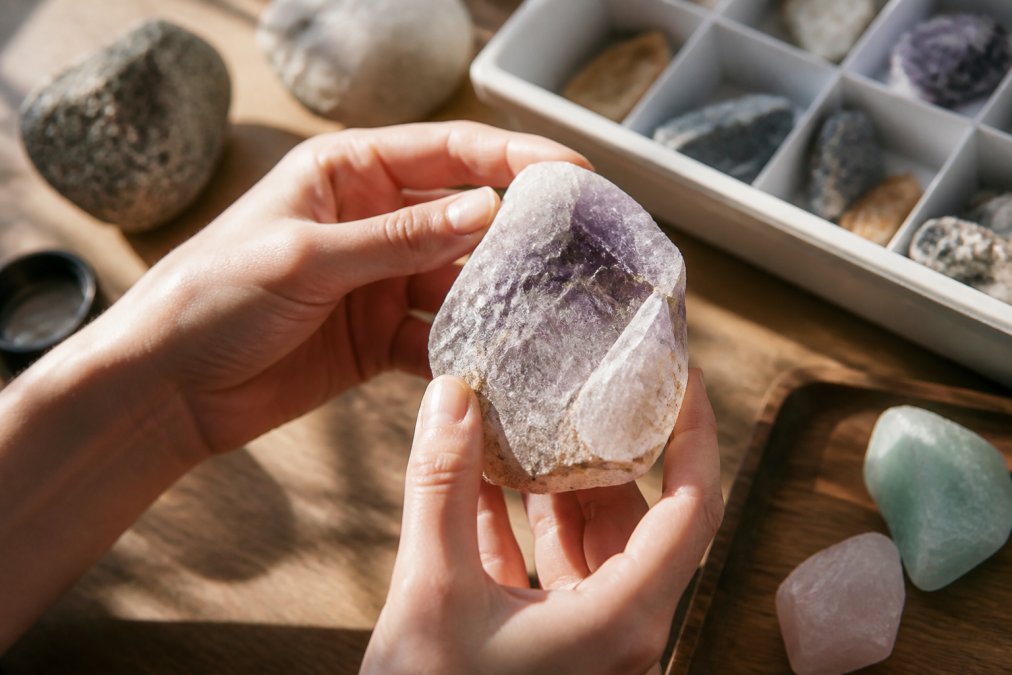
Synthetic crystals are lab-created minerals with the same chemical composition as natural stones but grown in controlled conditions. Lab-created amethyst is chemically identical to mined amethyst but costs a fraction of the price. However, sellers often misrepresent synthetics as natural, commanding premium prices.
Dyed crystals have been artificially colored to enhance or change their natural hue. The dye fades over time with sun exposure, revealing the original color underneath (peer-reviewed research). This is deceptive marketing disguised as product enhancement.
Heat treatment is common and generally accepted in the crystal industry. The issue arises when sellers don't disclose treatment. You should know whether a stone's color is natural or enhanced.
Identifying treated stones requires hands-on inspection:
- Color pooling: Dyed stones show uneven color distribution, often concentrated at fractures or edges. Natural color is typically uniform throughout.
- Surface coating: Run your finger over the stone. A grainy or sticky texture suggests dye coating.
- Fading: Expose a suspect stone to direct sunlight for a week. If the color noticeably fades, dye was applied.
- Price inconsistency: If a stone costs significantly less than market rate, it's likely treated or synthetic.
Ethical suppliers disclose all treatments explicitly. Their product descriptions state: "Heat-treated for color enhancement," "Dyed," or "Lab-created."
Crystal Supply Chain Transparency: What to Look For
Supply chain transparency means you can trace a crystal from extraction through processing to your hands. This requires documentation at each step: mine location, extraction method, processor details, distributor information, and final seller.
Most crystal suppliers cannot provide complete supply chain documentation. Ethical suppliers break this pattern by working directly with mining operations or maintaining detailed records of their sourcing.
Transparency documentation includes:
- Mine location and operator name: Specific geographic origin, not vague regional references
- Extraction method: Artisanal, small-scale, or industrial mining
- Labor certification: Third-party audits confirming fair wages and safe conditions
- Environmental impact statement: Mining practices and remediation efforts
- Processing details: How the crystal was cut, polished, or treated
- Chain of custody records: Each party in the supply chain from mine to retailer
Wholesalers typically prioritize volume over traceability and cannot provide detailed sourcing information. Retail suppliers like Liv Rocks, who curate smaller selections, can maintain relationships with sources and document practices.
Ask suppliers: Can they provide written sourcing documentation? Can they name the mining operation? Do they have environmental or labor certifications? If the answer to any of these is "no," they cannot credibly claim ethical sourcing.
Questions to Ask Your Crystal Supplier
Direct communication with your supplier is the most reliable verification method. The questions you ask reveal whether they take ethical sourcing seriously or are simply using the term as marketing language.

Before purchasing, contact the supplier and ask these questions in writing (email is best):
-
Where was this crystal mined? Request the specific country, region, and mining operation name. Vague answers indicate they don't know or won't disclose.
-
Who extracted this crystal, and under what conditions? Ask whether it was artisanal, small-scale, or industrial mining. Request documentation of labor practices and wages.
-
Has this crystal been treated, dyed, or heat-treated? Demand full disclosure of any processing beyond cutting and polishing.
-
Do you have third-party labor audits or environmental certifications? Ask for copies or links to verification documents.
-
Can you provide a chain of custody document? This shows every party involved from mine to your hands.
-
What is your environmental remediation commitment? Ask how mining operations address habitat restoration and water quality.
-
How do you verify your suppliers' practices? Do they conduct audits, site visits, or maintain ongoing relationships?
-
What happens if I find the crystal doesn't match your sourcing claims? A strong return policy indicates confidence in their sourcing.
Ethical suppliers answer these questions directly and provide documentation. They may take 5-10 business days to respond because they're actually researching their inventory. Suppliers who respond with vague reassurances or refuse to provide details are not committed to ethical sourcing.
How to Buy High Quality Crystals Online Responsibly
Purchasing ethically sourced crystals online requires research, verification, and willingness to pay premium prices. High-quality, ethically sourced crystals cost more because responsible sourcing requires investment in relationships, documentation, and verification.
Online purchasing creates distance between you and the source, making verification harder. This is why supplier reputation and documentation become critical.
Responsible online purchasing follows these principles:
- Prioritize suppliers with detailed sourcing documentation over those making vague ethical claims
- Compare prices within reason, but understand that ethical sourcing costs more
- Check return policies that allow inspection and verification before final purchase
- Read customer reviews specifically about sourcing claims, not just aesthetic satisfaction
- Verify certifications directly by contacting the certifying organization
Liv Rocks offers ethically sourced crystals with complete sourcing documentation and a 30-day return policy. Our pricing reflects the cost of ethical sourcing: hand-selection, supplier vetting, and direct relationships with mining operations. Each crystal is smudged to clear old energies before shipping.
When evaluating online retailers, look for:
- Specific sourcing information on product pages
- Supplier contact information and transparency about their sourcing process
- Customer testimonials mentioning sourcing quality
- Clear treatment disclosure for every product
- A physical address and phone number
Online retailers operating without this infrastructure are prioritizing convenience over ethics.
Verification Steps You Can Take Today
You don't need to be a geologist to verify ethical sourcing. These practical steps provide reasonable assurance that your crystal supplier is genuine.
Step 1: Request written sourcing documentation (Time: 15 minutes) Email your supplier and ask for sourcing details on a specific crystal. Request: mine location, extraction method, labor practices, environmental commitments, and treatment disclosure.
Step 2: Verify supplier claims independently (Time: 30 minutes) Search online for the mining operation, region, or certifications they mention. Contact third-party certifiers directly to confirm the supplier's certification status.
Step 3: Examine the physical crystal (Time: 20 minutes) Inspect the stone for signs of treatment: uneven color, surface coating, or unnatural clarity. Compare photos to reference images of untreated stones.
Step 4: Test the supplier's responsiveness (Time: ongoing) Ask follow-up questions about anything unclear. Ethical suppliers answer questions thoroughly.
Step 5: Check return policies and customer reviews (Time: 15 minutes) Review return policies for flexibility if sourcing claims don't hold up. Read customer reviews mentioning sourcing quality.
Step 6: Build a relationship with one trusted supplier (Time: ongoing) Once you identify a supplier who answers questions thoroughly and provides documentation, prioritize purchasing from them.
| Verification Step | Time Required | What It Reveals |
|---|---|---|
| Request written sourcing documentation | 15 minutes | Supplier's knowledge and transparency |
| Verify claims independently | 30 minutes | Accuracy of sourcing statements |
| Examine physical crystal | 20 minutes | Signs of treatment or synthetic origin |
| Test supplier responsiveness | Ongoing | Commitment to customer transparency |
| Check return policies and reviews | 15 minutes | Supplier reputation and confidence |
| Build trusted supplier relationship | Ongoing | Deepening accountability and trust |
These steps take roughly 90 minutes per purchase. This investment pays dividends: you gain confidence in your crystals' origins and support suppliers who prioritize ethics.
Verifying ethically sourced crystals requires active engagement with suppliers and willingness to ask hard questions. The crystal industry lacks central certification, which means you bear responsibility for due diligence. Liv Rocks simplifies this process by maintaining direct sourcing relationships, providing complete documentation, and standing behind every crystal with transparent practices. When you purchase from a supplier committed to ethical sourcing, you're supporting responsible mining practices and fair labor conditions.
Frequently Asked Questions
How can I tell if a crystal is actually ethically sourced?
Ethically sourced crystals come with documentation of geological origin, mining method, and labor practices. Ask suppliers for sourcing certificates, information about artisanal versus industrial mining, and confirmation that no child labor was involved. Transparent sellers provide details about where crystals were extracted and how workers were treated. If a supplier cannot answer these questions directly, that's a red flag. Look for vendors who openly discuss their supply chain and partner directly with ethical mining operations.
What's the difference between ethically sourced and fair trade crystals?
Ethical sourcing focuses on minimizing environmental damage, ensuring fair wages, and maintaining safe working conditions during extraction. Fair trade certification goes further by requiring independent verification and ongoing compliance audits. However, there is no centralized fair trade body for crystals like there is for coffee or chocolate, so fair trade claims vary widely. When evaluating ethically sourced crystals, verify specific practices rather than relying on labels alone. Ask whether miners receive fair compensation above subsistence wages and whether environmental remediation occurs after extraction.
How do I identify fake or heavily treated crystals?
Fake crystals are often made from glass or synthetic materials, while treated stones have been artificially altered to enhance color or appearance. Check for uniform coloring, which suggests dyeing or synthetic creation. Real crystals typically show natural color variation and inclusions. Synthetic stones often have perfect clarity that looks unnatural. Ask suppliers about treatment policies and whether stones have been dyed, irradiated, or heat-treated. Request information about the crystal's geological origin and natural properties. Price can also signal authenticity: extremely low prices for high-quality specimens often indicate fakes or heavy treatment.
What environmental practices should an ethical crystal supplier follow?
Responsible suppliers minimize carbon footprint through efficient mining techniques and local distribution. They should implement environmental remediation standards to restore mining sites after extraction. Sustainable practices include water conservation, waste reduction, and habitat protection. Ask whether suppliers work with artisanal miners who use less invasive methods than industrial operations. Inquire about their commitment to reducing conflict minerals in their supply chain and whether they source from regions with strong environmental regulations. Transparency about mining locations and methods indicates genuine commitment to environmental responsibility.